Precision Sheet Metal Fabrication
Overview
Preserved shop record for cliftonprecision.com. The former plant is not quoting from this domain. The preserved pages read like a working toolroom’s own shorthand: presswork, machining, laser scanning, low cost resources, industries served. The navigation alone tells you what the shop considered its core trades. Machining, Presswork, Laser Scanning. Under Industries, the list runs Aerospace, Automotive, White Goods. The laser scanning page describes a portable laser arm scanner used for reverse engineering, quality inspection, and precision 3D data capture. The services page lists the software stack: NC Graphics toolmaker for 2D and 3D tool design and 3D surface manipulation, Machining Strategist for 3D machining, AutoCAD 2000, Rhino 3D for solid modelling and 3D surface manipulation, Optris virtual press simulation solver for die development and stress analysis, PAM DieMaker for intera
Details
ctive die addendum creation, Renishaw 3D scan software for full reverse engineering. The machine list is specific: six CNC Hurco machining centres with Ultimax software and a travel range of 1700 x 600 x 500, one Zayer CNC machining centre with Heidenhain 426 control and a travel range of 4000 x 2500 x 1500, one Fil CNC machining centre with Heidenhain 426 control and a travel range of 2000 x 1000 x 1000. The machining page adds that all CNC’s are fully networked and linked to the CAD CAM office for direct data transfer, using DXF translator for programming direct from tool drawings. It also notes 24 hour machining capacity on eight Hurco machining centres, capacity up to 1.7m x 0.6m x 0.5m, set up specialising in one offs and bespoke developments and small batch work, with experience in aerospace materials, plastics, polystyrene, model board, tool steels, wood and marble. The CNC machining page describes two well equipped CNC machining shops with surface grinders, optical profile grinders, lathes and manual milling machines supporting eight full 3D CNC machining centres ranging in size up to a total capacity of 4 metres x 2.5 metres x 1.25 metres and a weight capacity of up to twenty tonnes. It also mentions 2/2.5D wiring and sparking using NC Graphics programming system, and five CNC Charmilles Tec Robofil sparker eroder machines including 2000/4000/6000 and the new 510, capacity ranging from 320x220x350 to 700x. The electrode discharge machining page adds a complete range of high precision electrode discharge machining including five Charmilles Robofil EDM machining centres, a Charmilles Roboform EDM sparker, and a Charmilles deep hole sparker eroder. The Hurco page says the company works closely with customers at all stages of new product development from prototype to final production, and that premier press tool manufacturers demand a combination of outstanding traditional skills and craftsmanship supported by high technological expertise and project management techniques. That is the shop’s process language. Precision sheet metal fabrication, read through this record, is not a separate department bolted onto a machining business. It is the same toolroom logic applied to flat stock: develop the blank, control the form, verify the result. The preserved pages do not use the phrase “precision sheet metal fabrication” as a heading, but the process chain is there. Presswork sits beside machining in the navigation. The press simulation and die development software sits beside the CNC programming. The laser arm scanner sits beside the CMM-style inspection language of comparing accurate digital models with CAD to ensure products meet intended design. The shop’s own words for that are quality inspection and reverse engineering. For sheet metal work, those words matter because the first part is often a hand-worked or legacy component with no usable CAD. The scanner captures hand-worked changes for CAD. The CAD CAM office then programs direct from tool drawings using DXF translator. The machining centres cut the form tools, the presswork forms the sheet, and the scanner checks the result against the intended design. The materials list from the machining page is also instructive. Aerospace materials, plastics, polystyrene, model board, tool steels, wood and marble. That is not a sheet metal list, but it is a toolroom list. In precision sheet metal fabrication, the tool steel is the die, the model board is the pattern or check fixture, the aerospace materials are the production stock. The shop’s experience with one offs and bespoke developments and small batch work is the same discipline needed for prototype sheet metal: a single blank, a single form, a single check, then a small batch. The 24 hour machining capacity on eight Hurco machining centres and the larger Zayer and Fil centres give the toolroom the ability to cut press tools, form blocks, and fixtures without waiting on outside capacity. The EDM range gives it the ability to finish hard tooling after heat treatment, which is where precision sheet metal fabrication often lives or dies. A form die that is wire eroded and spark eroded to the CAD model will hold its edge and its radius better than a die that is only milled. The laser scanning page is the quality thread. It says the portable device offers a wide range of services. Reverse engineering: create accurate digital models of existing components, re-design and reengineer parts or capture hand-worked changes for CAD. Quality inspection: compare accurate digital models with CAD to ensure products meet intended design. For precision sheet metal fabrication, that means a formed bracket, a chassis, a panel, or a press tool can be scanned and compared to the CAD. The shop can capture a hand-worked change on a prototype and feed it back into the CAD. It can re-engineer a legacy part where the original drawing is gone. It can inspect a first-off from a new die before committing to a batch. The Renishaw 3D scan software is listed alongside the other software, so the scan data is not a dead end. It goes into the same CAD CAM office that programs the CNC machines and the EDM machines. The industries list ties the process to the markets. Aerospace, Automotive, White Goods. National Heritage. Medical. Motorsport. Leisure. Those markets each ask something different from precision sheet metal fabrication. Aerospace asks for traceable materials and tight form tolerances. Automotive asks for repeatability at volume. White goods ask for cost-effective tooling and durable finishes. National Heritage asks for reverse engineering and one-off replacement. Medical asks for clean forming and accurate inspection. Motorsport asks for rapid prototype to production. The preserved pages do not claim certifications, and this record does not invent any. What the pages do claim is capability: the software, the machine list, the scanner, the EDM range, the presswork, the experience in one offs and bespoke developments and small batch work. That is the shop’s own process language, and it is enough to describe how precision sheet metal fabrication was approached inside this plant. The former plant is not quoting from this domain.
Drill size reference
| Drill | Decimal inch | Millimetres |
|---|---|---|
| #1 | 0.2280 | 5.791 |
| #7 | 0.2010 | 5.105 |
| #13 | 0.1850 | 4.699 |
| #21 | 0.1590 | 4.039 |
| #29 | 0.1360 | 3.454 |
| #36 | 0.1065 | 2.705 |
| #43 | 0.0890 | 2.261 |
| #53 | 0.0595 | 1.511 |
| 1/16 | 0.0625 | 1.587 |
| 5/64 | 0.0781 | 1.984 |
| 3/32 | 0.0938 | 2.381 |
| 7/64 | 0.1094 | 2.778 |
| 1/8 | 0.1250 | 3.175 |
| 9/64 | 0.1406 | 3.572 |
| 5/32 | 0.1562 | 3.969 |
| 11/64 | 0.1719 | 4.366 |
| 3/16 | 0.1875 | 4.763 |
| 13/64 | 0.2031 | 5.159 |
| 7/32 | 0.2188 | 5.556 |
| 15/64 | 0.2344 | 5.953 |
| 1/4 | 0.2500 | 6.350 |
| 5/16 | 0.3125 | 7.938 |
| 3/8 | 0.3750 | 9.525 |
| 7/16 | 0.4375 | 11.113 |
| 1/2 | 0.5000 | 12.700 |
| F | 0.2570 | 6.528 |
| H | 0.2660 | 6.756 |
| L | 0.2900 | 7.366 |
| P | 0.3230 | 8.204 |
| S | 0.3480 | 8.839 |
| W | 0.3860 | 9.804 |
| Z | 0.4130 | 10.490 |
Common questions
What is a #1 drill bit in inches and millimetres?
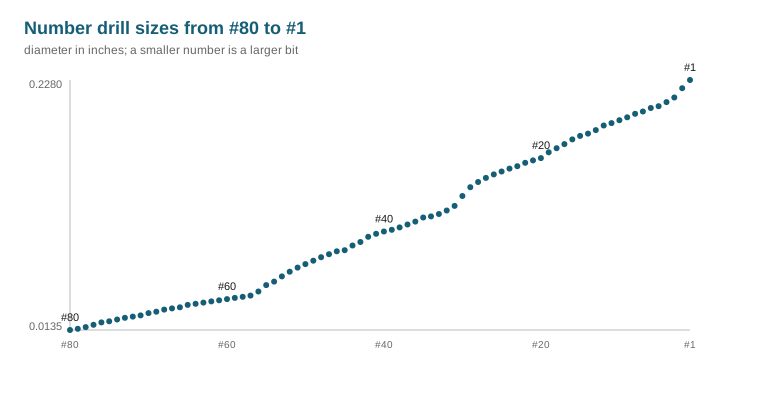
A #1 drill bit is 0.2280 in, which is 5.791 mm. Number drills run from #80 at 0.0135 in up to #1 at 0.2280 in, so a smaller number is always a larger bit.
What is a #7 drill bit in inches and millimetres?
A #7 drill bit is 0.2010 in, which is 5.105 mm. Number drills run from #80 at 0.0135 in up to #1 at 0.2280 in, so a smaller number is always a larger bit.
What is a #13 drill bit in inches and millimetres?
A #13 drill bit is 0.1850 in, which is 4.699 mm. Number drills run from #80 at 0.0135 in up to #1 at 0.2280 in, so a smaller number is always a larger bit.
This page is an archival note for informational purposes only. It does not offer representation, evaluate claims, or create a professional relationship.